


This one took some time to write because I've been teetering between navigating the overwhelming awareness of terror in the world and living life.
I have grappled with what is enough. I have wrestled with what complacency looks like. I have scrutinized the privilege of safety. I have watched children being pulled lifelessly from rubble. I have heard imaginary debates about the irrefutable value of a life. I have seen politicians and "thought leaders" recite jargon to fill up media minutes while bombs explode through the night.
All of it has made me feel helpless, and for a while, I was paralyzed by that feeling.
I have called my local representatives to demand a ceasefire and will continue to do so. I share resources on my Instagram stories and Twitter page. I have written emails, sent texts, signed petitions, and watched discussions and lectures. And though we live in a world that has convinced us our liberation must be grounded in hatred, the heaviness in my chest only seems to be relieved by love, not anger.
So, I've also paced myself in the mornings. I've said yes to things I might otherwise find an excuse not to do. I've felt a heightened need for compassion, not just for my people but for PEOPLE.
I've sat in a crowded, busy subway car and heard beauty instead of chaos. I've released my tendency to be annoyed by annoying things and, instead, access empathy when it feels out of reach.
I’ve spent a lot of time reflecting on my impact, my role and whether my voice adds anything necessary to the noise. As a writer, I always feel tasked with speaking up, and over the last year, I have chosen instead to hibernate, to rest. I speak less to my timeline and more to my son, to my friends, to my family.
When the Twitter community I loved dissipated after Elon’s cartoonish takeover, I realized how fleeting digital spaces are. How critical physical gatherings and real-life conversations are. Why it feels more important to know your neighbors than to know your followers.
The other night, as my son dug through a harvest of Halloween candy, I watched the Palestine Festival of Literature’s broadcast of “But We Must Speak On Palestine and the Mandates of Conscious,” which took place in New York City and was graciously broadcast live on YouTube. It featured Palestinian, Black, and POC voices sharing views, poetry, and experiences as a collective voice for voiceless Palestinians. At one point, historian Professor Rashid Khalidi of Columbia University sat down to talk to Ta-Nehisi Coates.
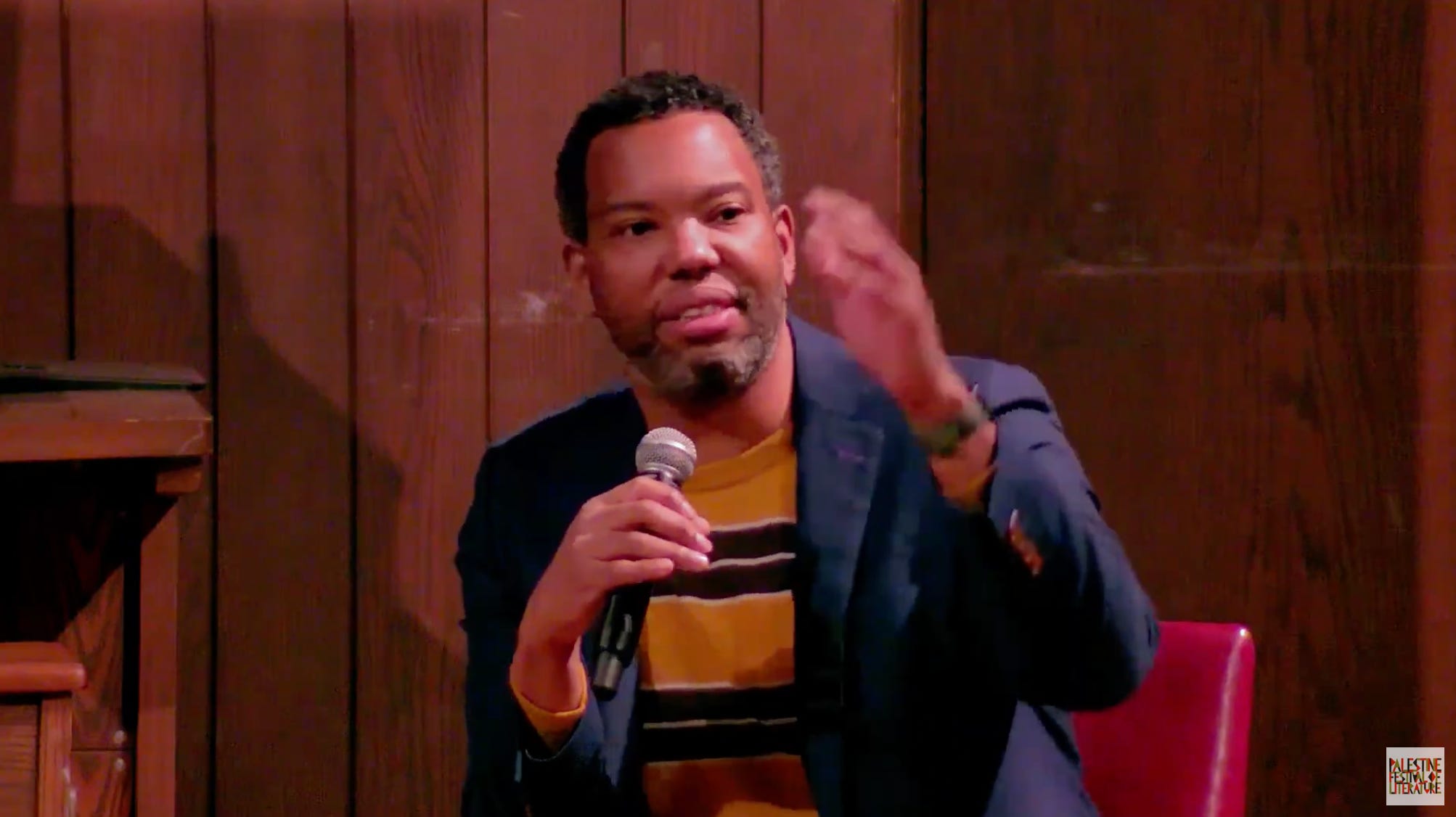
Coates reflected on his brief but deeply impactful trip to Palestine, which jolted his view into expansion and invigorated his activism for the people there. At one point during the discussion, he spoke about seeing his local congressman on TV respond to the question, “How do you measure the body count? At what point is it too much?” The congressman replied, “I don’t know,” which Coates said saddened him but also resonated.
“Because I understood it,” said Coates, “And I understood how the rage, the anger, the deep-felt pain of your own oppression—how you can take the wrong lesson from it.”
There’s an irritating familiarity between the open-air prison of Palestine and the seemingly free streets of America. Our oppression looks different sometimes but feels the same. Limited access to resources, destroyed schools and hospitals, and a dehumanizing propaganda campaign to justify the eradication of entire peoples.
Same branding, different roll-out.
I realized the reason I feel so paralyzed is that I’m so used to digging down to the core of a thing. I don’t like superficial talking points; I don’t like to dabble in needless discourse. I don’t want to argue with anyone about the value of human life, whether the life in question is that of 300 Palestinian protesters or a single unarmed Black man.
Last year, I was on set with CRWNMAG to produce a cover and interview with doula and birth work educator Latham Thomas. It was also the day Roe v. Wade was overturned, and I remember feeling a similar pang of futility and fatigue. Instead of rehashing buzzy talking points to criticize SCOTUS, Latham said something that has remained in my bones ever since and offers a reprieve from my guilt when I’m too tired to be full of rage.
"There are people who dismantle and people who build," she said. "I'm on the side of building things. And I love people who tear things up. I need people who burn things down."
Most days, my ministry is my home, the peace within it, and the ripple effect that peace produces. My battle is my son's middle school education, his sudden need for extra hugs, my health, and my emotional recovery from devastating blows.
All the horrors we see on the news stem from a hatred that we've been steeped in so long that it's become second nature. We argue, debate, and go back and forth with our perceived enemies like we are not both prisoners. We end up exhausted and emotionally martyred to prove we'll die for something. I don’t think my exhaustion matters more than my capacity for love.
For the past eleven years, anytime there is terror or destruction in the world, all I see are parents.
I see mothers just like me who fuss over their kids and who exist with the kind of worry that is innate to this role. Our constant worry is not just that the world might swallow up our children but that the world won't be there for them when they grow up. We force ourselves to believe that the world will hurry up and heal by the time it greets our kids.
Daily, we measure out this worry — a little here, a little there — so as not to be swallowed by it unless absolutely necessary.
Because of this worry, I am less concerned with the historical facts (although I’ve read them) and political talking points (although I've heard them) and more concerned with the collective state of humanity and the indisputable awareness that a collective shift is imminent. Every genocide must end, including the one happening slowly and silently beneath our feet.
I accept that nothing will feel like enough right now. But we can stretch ourselves to effect change in the general direction of freedom. And we can do the uncomfortable work of taking action while also doing the tediously necessary work of self-love.
Get rest, drink water, and hug your people for those who can't. Forgive your ignorance because there is always more to learn. Share what feels informative, urgent, and helpful. And preserve your heart so as not to perpetuate the very hatred that genocides are born from. This, too, is radical.
Anyway, free Palestine. And free all of us.
7 Things to Do If You’re
Not Sure Where to Start:
Tap your local reps to demand a ceasefire. Start here.
Share, like, bookmark/save content that spreads awareness.
Read The Hundred Years’ War on Palestine, Freedom Is a Constant Struggle and this essay by Zeba Blay, which includes a list of things to read, watch and listen to.
Listen to podcast episodes that explain and follow the Palestine-Israel conflict. My recent favorite is this one from Around the Way Curls (25:40 mark). Others are The Daily, The Ezra Klein Show, and Democracy Now!
Go down the Wikipedia rabbit hole, and be sure to check sources and citations as you go. Start here.
Learn about the boycott movement and consume products mindfully.
Follow informative folks like Marc Lamont Hill, Sim Kern, and Olayemi Olurin.