


This week, a podcast episode I recorded about a year ago with author, Sara Petersen for The Cult of Perfect dropped and I gleefully revisited the conversation as I fixed my morning coffee. I kind of light up when it’s time to talk about single parenthood, particularly motherhood, and particularly Black single motherhood because I get to dispel some of the ugly but common misconceptions about women raising children without a traditional partner in the home.
I find this conversation so often leads to the broader topics of womanhood, the societal limitations placed on women’s personhood, and the ways our bodies are still policed by archaic standards whether we have children or not.
Which is why I take every opportunity I can to shake this table. To say, “Can we please analyze marriage, housing, religion, community, media….before we decide that the problem is women?”
In my conversation with Sara, I talked a lot about how marriage is over-celebrated and how our obsession with this singular version of family — the nuclear family — as the ultimate show of adulthood and personal fulfillment not only perpetuates the notion that all other families are “broken,” but that the only way a woman can be an asset to her community is if she is married with children.
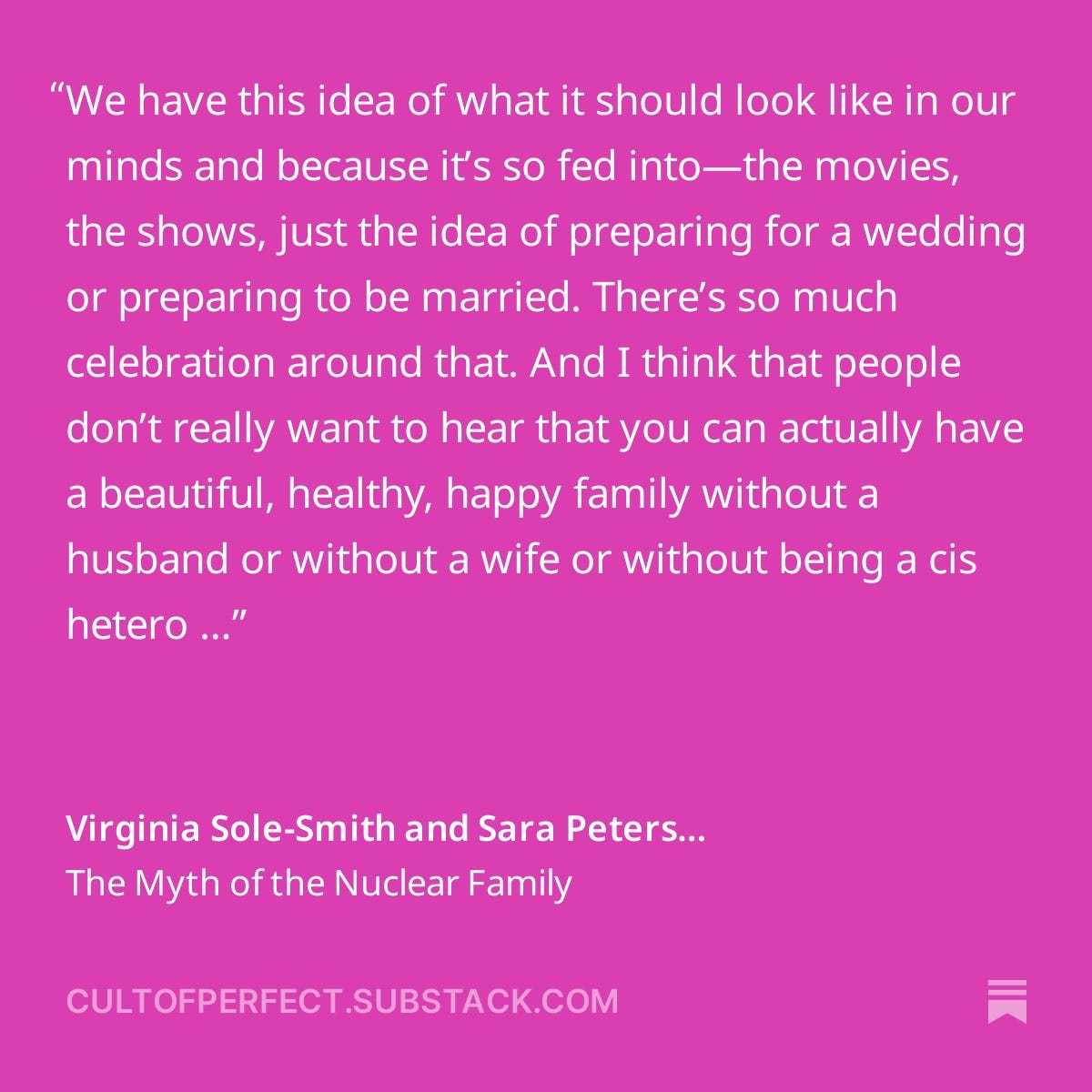
I’ve written about single motherhood extensively because this is my lived experience. I am a divorced mother, raised by a divorced mother, raised by a divorced mother. I know that what is often lacking is not the presence of a cis male husband, but the presence of community. We focus so intently on the nuclear family, that we lose emphasis on the chosen family, especially in this era of siloed, digital, and remote life. We are taught to find husbands, not how to find community. We’re celebrated for achieving marriage, not for achieving personhood.
I talk about community a lot. And not just my physical community, the city blocks surrounding my home, but the collective of people who make up my chosen family. Last month, I wrote about the importance of aunties for Parents magazine and sparked a viral conversation on Twitter about that one auntie who carried us through, showed up, expanded our perceptions, and served as a safe space when our parents were otherwise unavailable.
I specifically wanted to honor aunties because society tends to misunderstand two types of Black women the most: mothers without husbands and women without kids. In the same ways I have felt limited by definitions of successful parenthood, my kid-free friends have felt limited by similarly ignorant definitions of successful adulthood.
In short, self-defined, liberated women scare the shit out of people.
It’s been almost a decade since my ex-husband and I separated, effectively becoming single parents to our son and co-parents to each other. And because I chose not to lose sight of my value, I had to devalue some of what I was taught about families. That fathers are incapable of unsupervised parenthood, that children must witness marriage to understand love, that good mothers cannot also be vulnerable, sexual, and human, and that parenthood should be at the center of everything we do.
These past several years have influenced me to become an advocate for mothers, especially those in transition because I know the internal battle that has to be won before anything else can be resolved.
Every month or so I get a DM or text or email that says, “My friend just got divorced and I sent her that article you wrote,” and it brings things full circle. Because I tend to write the things I needed to read a decade ago, that my mother needed to read thirty years ago, that my grandmother needed to read fifty years ago. And the community I have found through this work has nurtured me in ways I can never pay back, but I can pay forward.
Starting January 4th, my friend and mental health coach, Morgan Morrison and I will launch a weekly support group for Black women navigating both motherhood and singlehood. The Mothering While Single group will meet online once a week for eight 1.25-hour sessions, and be guided by my lived experience and Morgan’s expertise as a mental health coach. Each week we’ll discuss a different topic, from nurturing a positive co-parentship to talking to kids about divorce and separation. We’ll also cover dating, self-care, loneliness, and balancing parenthood with work and ambition.
I had to stop myself from basically copying and pasting huge paragraphs of your essay into the comments section and just saying “this” or “bars.” Suffice it to say that I’ve missed your words and value your perspective because it expands my very black and white worldview (e.g. I’m a failure because I might not be able to have biological children).
I think the space you and Morgan are creating will be the community that you need now and needed 10 years ago, that your mom needed 30 years ago, and that your grandma needed 50 years ago. I’m so happy you’re co-creating that space for us.
Alright, alright. I couldn’t help myself:
“And because I chose not to lose sight of my value, I had to devalue some of what I was taught about families.”
This. Bars.
Love these lines right here “I tend to write the things I needed to read a decade ago, that my mother needed to read thirty years ago, that my grandmother needed to read fifty years ago. And the community I have found through this work has nurtured me in ways I can never pay back, but I can pay forward.” This work is so important. Thank you.